



Every role, broken into tasks.
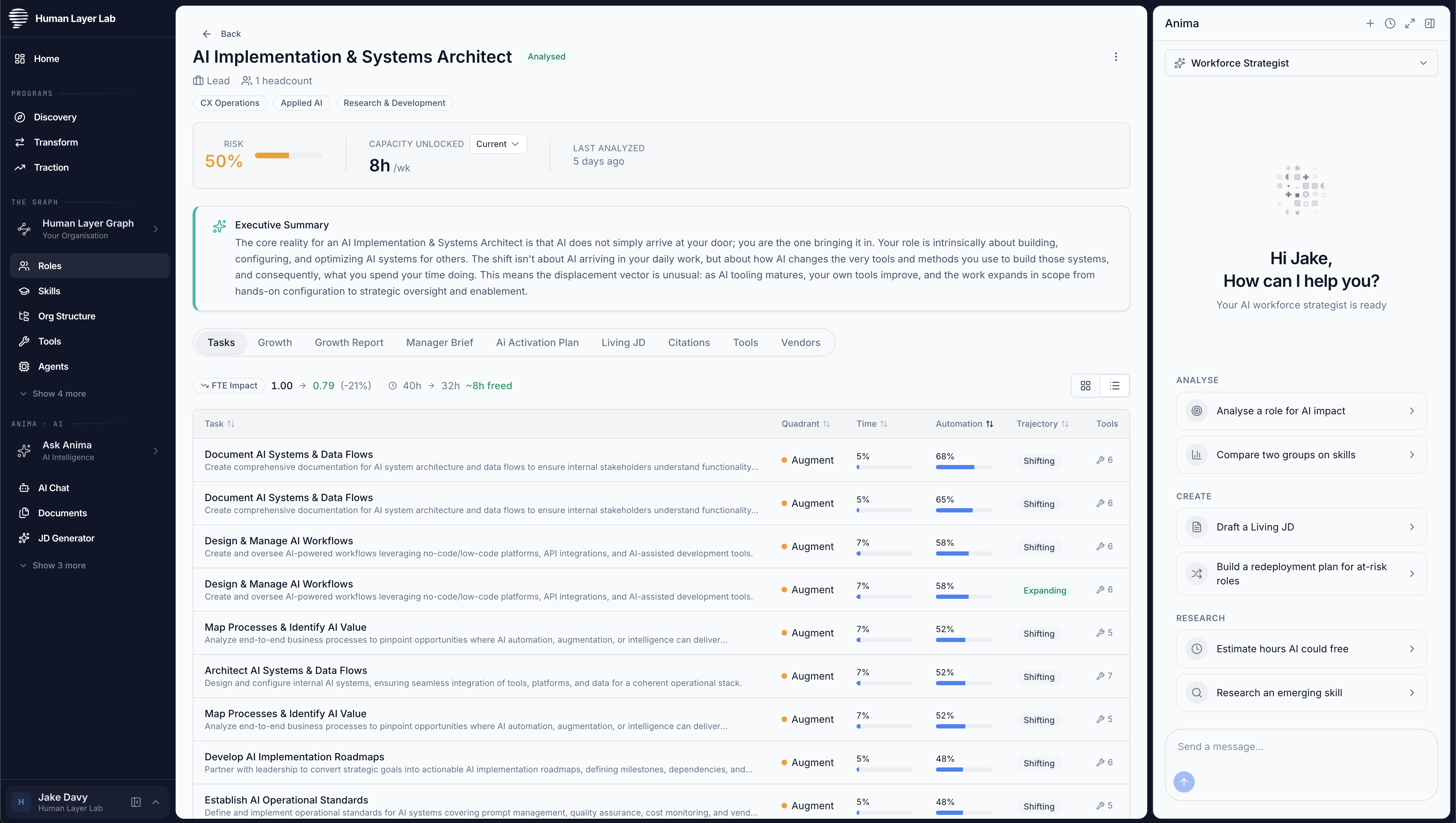
Roles don't get automated. Tasks do. This is our public analysis of how AI is changing the work inside 39 roles: which tasks shift first, what capacity that frees, and where each role grows from here.
Task-level, not headline-level.
Each role page here is a public excerpt. In the platform, every role is decomposed into its tasks, each scored for automation potential with evidence, and the capacity unlocked lands on the record.
Explore the dataset.
Task-level analysis across every department, free to read. Each score is a 0–100 measure of how much of the role's current task mix AI can already do or assist.
Showing 39 of 39 roles
Account Executive
AI handles the busywork of selling, but Account Executives are becoming strategic dealmakers who focus on complex negotiations, relationship building, and high-value consultative sales.
Account Manager
AI enhances client intelligence and automates routine tasks while relationship building remains the core human value.
Accountant
Routine bookkeeping and compliance tasks are automating, elevating the accountant role toward advisory and strategic finance.
Backend Engineer
AI writes more backend code than ever, but backend engineers are evolving from implementers to system designers who architect for scale, reliability, and AI integration.
Business Development Representative
Inbound lead qualification is increasingly automated. BDRs are evolving toward strategic opportunity development and partnership cultivation.
Compliance Analyst
AI transforms compliance from manual monitoring to strategic risk management and regulatory interpretation.
Content Writer
AI drafts content at scale while humans provide brand voice, strategic direction, and creative differentiation.
Customer Service Representative
Chatbots handle routine queries while human agents focus on complex issues requiring empathy and judgment.
Customer Success Manager
AI handles health scoring, usage analytics, and routine outreach. CSMs are evolving from account monitoring to strategic partnership.
Data Analyst
Natural language queries and automated insights are transforming data analysis, but human interpretation remains critical.
DevOps Engineer
AIOps and intelligent automation are transforming DevOps from reactive firefighting to proactive architecture.
Financial Analyst
Data gathering and report generation are increasingly automated, shifting focus to strategic interpretation and stakeholder advisory.
Frontend Engineer
AI generates components faster than ever, but frontend engineers are evolving from code writers to experience architects who bridge design and engineering.
Growth Marketer
AI runs more experiments faster than ever, but growth marketers are evolving from tacticians to strategists who design and orchestrate AI-powered growth systems.
HR Business Partner
A strategic advisory role where AI provides data and insights while human judgment drives organizational decisions.
Learning & Development Specialist
AI personalizes learning at scale while human specialists design strategy and facilitate transformational experiences.
Marketing Analyst
AI automates campaign analytics and reporting while human insight interpretation and strategic recommendations gain importance.
Marketing Manager
AI accelerates content production and analytics while strategic positioning and brand building remain distinctly human.
Operations Manager
AI optimizes processes and predicts issues while human leadership drives team performance and organizational change.
Performance Marketer
AI platforms optimize campaigns automatically, but performance marketers are evolving from bid managers to growth strategists who orchestrate AI-powered marketing systems.
Product Designer
AI generates designs at unprecedented speed, but product designers are becoming strategic partners who own end-to-end experiences and product direction alongside PMs and engineers.
Product Manager
AI accelerates research and documentation while human judgment remains essential for strategy and stakeholder alignment.
Project Manager
AI optimizes scheduling and tracking while human leadership, stakeholder management, and team motivation remain irreplaceable.
QA Analyst
AI-powered test generation and automated execution are transforming QA from test execution to quality strategy.
Recruiter
AI accelerates sourcing and screening while relationship building and candidate assessment remain distinctly human.
Revenue Operations Manager
AI integrates data and automates workflows across the revenue stack. RevOps is evolving from system administration to strategic revenue architecture.
Risk Analyst
AI accelerates risk modeling and monitoring while human judgment remains essential for complex risk assessment and strategic decisions.
Sales Operations Analyst
AI automates reporting, CRM hygiene, and forecasting. Sales Ops is evolving from data administration to strategic revenue operations.
Sales Development Representative
AI prospecting tools are everywhere. The SDR role is not disappearing. It is compressing and elevating toward precision outreach and strategic qualification.
SEO Specialist
AI writes content and handles technical audits, but SEO specialists are evolving toward AI search optimization, content strategy, and the new landscape of answer engine optimization.
Software Engineer
AI coding assistants are transforming how code is written, but the role is expanding rather than shrinking.
Staff Engineer
AI makes individual contributors more productive, but staff-level technical leadership becomes essential as organizations navigate complex AI-augmented systems.
Supply Chain Analyst
AI-powered demand forecasting and optimization are transforming supply chain analysis from calculation to strategy.
Support QA Analyst
AI now scores calls and chats automatically. QA analysts are evolving from reviewers to quality architects who design standards and handle edge cases.
Support Team Lead
Leading support teams now means orchestrating AI tools alongside human agents. The role is evolving from queue management to strategic coaching.
Tech Lead
AI accelerates individual contributors, but technical leadership becomes more critical as systems grow complex and teams navigate AI-augmented workflows.
User Researcher
AI analyzes feedback at scale, but user researchers are evolving from data collectors to strategic advisors who ensure organizations truly understand their users.
UX Designer
AI generates wireframes and UI patterns in seconds, but UX designers are evolving from production to direction, owning user research, experience strategy, and design systems.
Workforce Management Analyst
Traditional forecasting and scheduling are being automated. WFM analysts are evolving to manage AI capacity alongside human capacity.
Roll it up, and roles become capacity.
Because every role is mapped at the task level, the same analysis rolls up into skills: every skill in the organisation, with the hours behind it projected out 6, 12 and 24 months. That is what turns role analysis into workforce planning.
How the Human Layer Graph works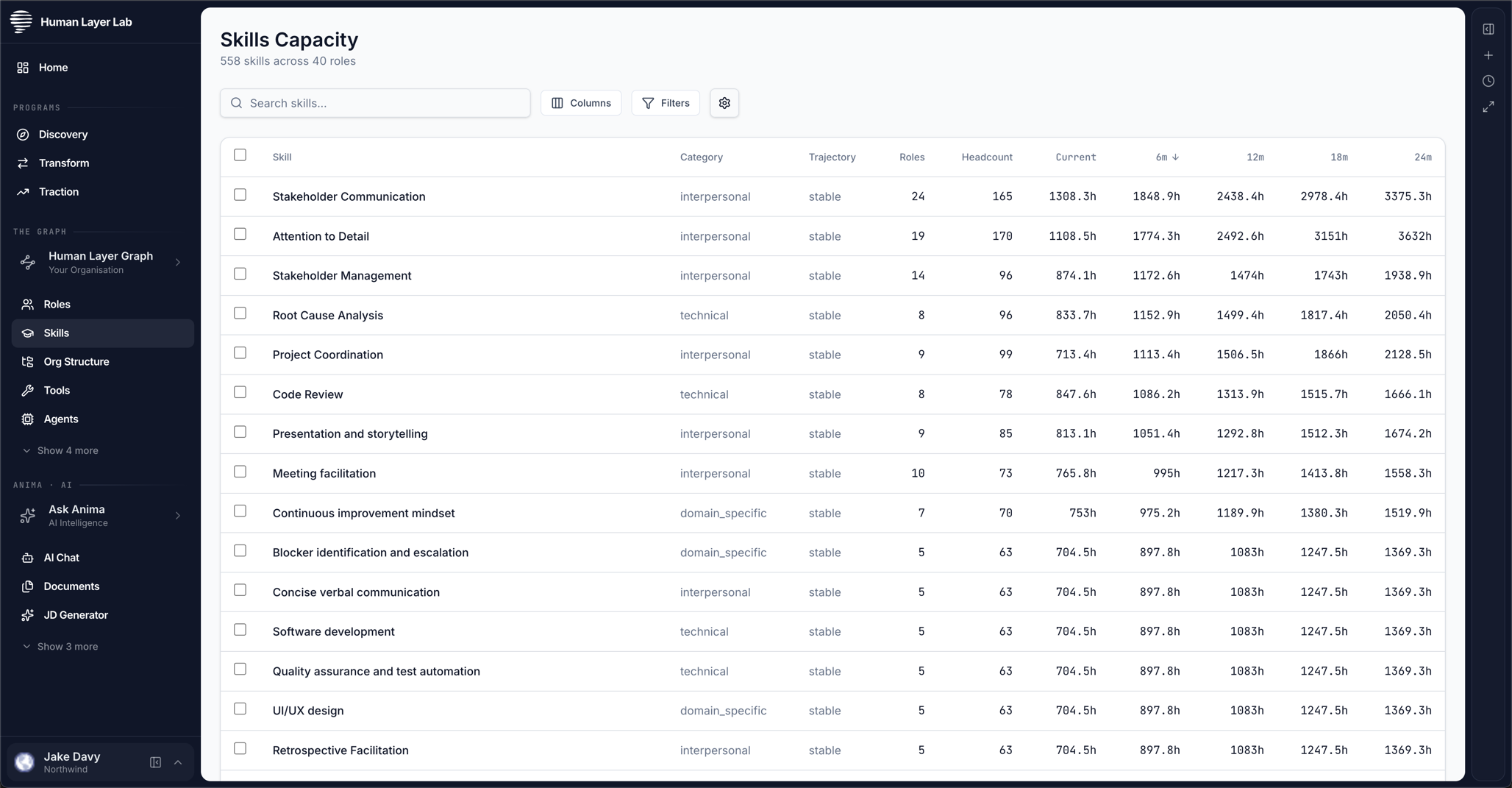
How the analysis works.
The same engine that runs client engagements produces these public analyses. Three moves, applied to every role.
Role into tasks
Every role is broken into the tasks it actually does, not the job description it was hired against.
Task by task
Each task is scored for automation potential against current AI capability, with the evidence attached.
Forward in hours
Scores roll up into capacity: the hours AI frees per role, projected out 6, 12 and 24 months.
Explore next
Industries
AI impact analysis by industry.
Read moreSolutions
Where to start, by the seat you sit in.
Read moreHuman Layer Graph
Your org as a living graph of roles, tasks, tools and processes.
Read moreInsights
Research and frameworks on AI transformation.
Read more
See your own roles in this detail.
These are general analyses. Start with Discovery and we baseline your actual roles, task by task, against your stack and your context.