




A role-by-role picture of AI's impact on your workforce.
Built in days, from the roles you already have. You get a living model of your workforce: where AI takes on the work, which skills are emerging, and exactly how to act on it. Plus board-ready reports for every role and department out of it.
- Duration
- 2 weeksfirst analysis back in 24 hrs
- Scope
- From 50 rolesthe roles you choose, not your headcount
- Price
- From $8,000USD, fixed and confirmed on the call
- You get
- A living modelof your workforce, and 6 documents per role out of it
Priced on the number of roles.
A fixed-scope programme, not a day rate. It starts at $8,000 USD for up to 50 roles and scales from there, with custom pricing above 250. Roles means the distinct roles you choose to analyse, not your headcount: a 500-person company might map to 75. Add-ons slide with the same role count, so the figure you see is the full first price.
All prices in USD. Other currencies are shown in the estimate below at indicative rates.
Assessment estimate
Move the slider to your role count. Roles means the distinct roles you choose to analyse, not your headcount.
Up to 50 roles · USD
- Growth Report, Manager Brief and AI Activation Plan for every role
- Workforce Impact Summary and a rollup for every department
- First analysis back in as little as 24 hours
Indicative, to help you plan. Final scope and price are confirmed on a short call. Non-USD figures use indicative rates.
Email us the shape of it and we'll come back with scope, price and timing. Your role count and estimate come pre-filled.
Go beyond roles when you're ready.
The assessment analyses your roles. Two add-ons extend the picture: your tools and vendors, and a full skills ontology. Each is $1,000 USD at the 50-role centrepoint and slides with your role count, so the calculator above gives you a full first price.
- Add-on 01Tools and vendorsMap every tool and vendor to the tasks they support, so the picture includes where AI now overlaps the stack you already pay for.
- Overlaps and gaps across the stack, visible for the first time
- Where AI now covers work you pay a vendor or licence for
- The consolidation signals that only appear in one connected model
- Add-on 02Skills ontologyMap the skills your teams actually hold, not the ones on paper, and get a living skills map of the whole workforce as the output.
- A visual skills map across roles, teams and the whole org
- The skills emerging as AI reshapes the work, surfaced early
- Where capability is concentrated, thin, or at risk
The Human Layer Graph
The add-ons start to connect your roles into the full graph: the living model of how your whole organisation works, with a visual skills map on top, and the foundation Transform and Traction run on later.
Added by the add-ons
Explore the graphMost companies are rolling out AI blind.
Tools get bought before anyone knows which tasks they change. Roles get redrawn on an org chart, detached from the work underneath. The assessment gives you the one thing every AI decision needs first: a role-by-role, task-level picture of your actual workforce, and how it evolves from here.
The problemCapacity is trapped in tasks nobody has mapped, so no one can say where AI would actually free time.
What the assessment doesEvery role scored task by task, so you see the hours AI can give back before you commit to anything.
The problemTools land across the org before anyone knows which tasks they change, or whether they land at all.
What the assessment doesGround every rollout in the real work, so spend goes where it moves the needle, not where it looks good.
The problemJob titles shift underneath you while restructures get drawn with no view of the work beneath them.
What the assessment doesA living model of how every role is changing, so redesigns follow the work instead of guessing at it.
A consultancy backed by an AI-native platform.
Built and run by a team with decades of combined product and engineering experience, from founders who previously scaled a global enterprise marketplace across 100+ countries.
- TraceableEvery finding traces back to task-level evidence.
- Human in the loopThe agents propose. Your people decide.
- Secure by designRegion-pinned data, SOC 2 Type II, Trust Center live.
You can't plan for AI at the level of a job title.
Every board asks the same question. What does AI do to our people? The answer comes back as a department, a headcount number, or a benchmark from somebody else's industry. None of it survives contact with the manager who actually runs the work.
One job title. Four different answers. The role isn't automated or safe; its tasks are moving in different directions at once, and only some of them need a human doing them next year.
A role never gets automated. Its tasks move: some to AI, some into a different shape of the same job, some into work that didn't exist last year. That is the level the answer has to be built at.
You don't get a document.
You get a living model.
Most assessments end in a PDF that starts going stale the day it lands. This one ends in a working model of your organisation: the graph, every role, every task, the whole skills picture, with the board-ready documents generated out of it and regenerated whenever the analysis underneath them moves.
Roles, tasks, skills, tools and processes, and every connection between them. Queryable, and it keeps living long after the assessment closes.
Every role and every task scored for AI impact, capacity and trajectory, with the market signals behind each score one click away.
Six board-ready documents per role, written from the two layers beneath them, and regenerated whenever those layers move.
One living, queryable model of how your organisation actually works: roles, tasks, skills, tools, processes and every connection between them. Not an org chart, and not a snapshot.
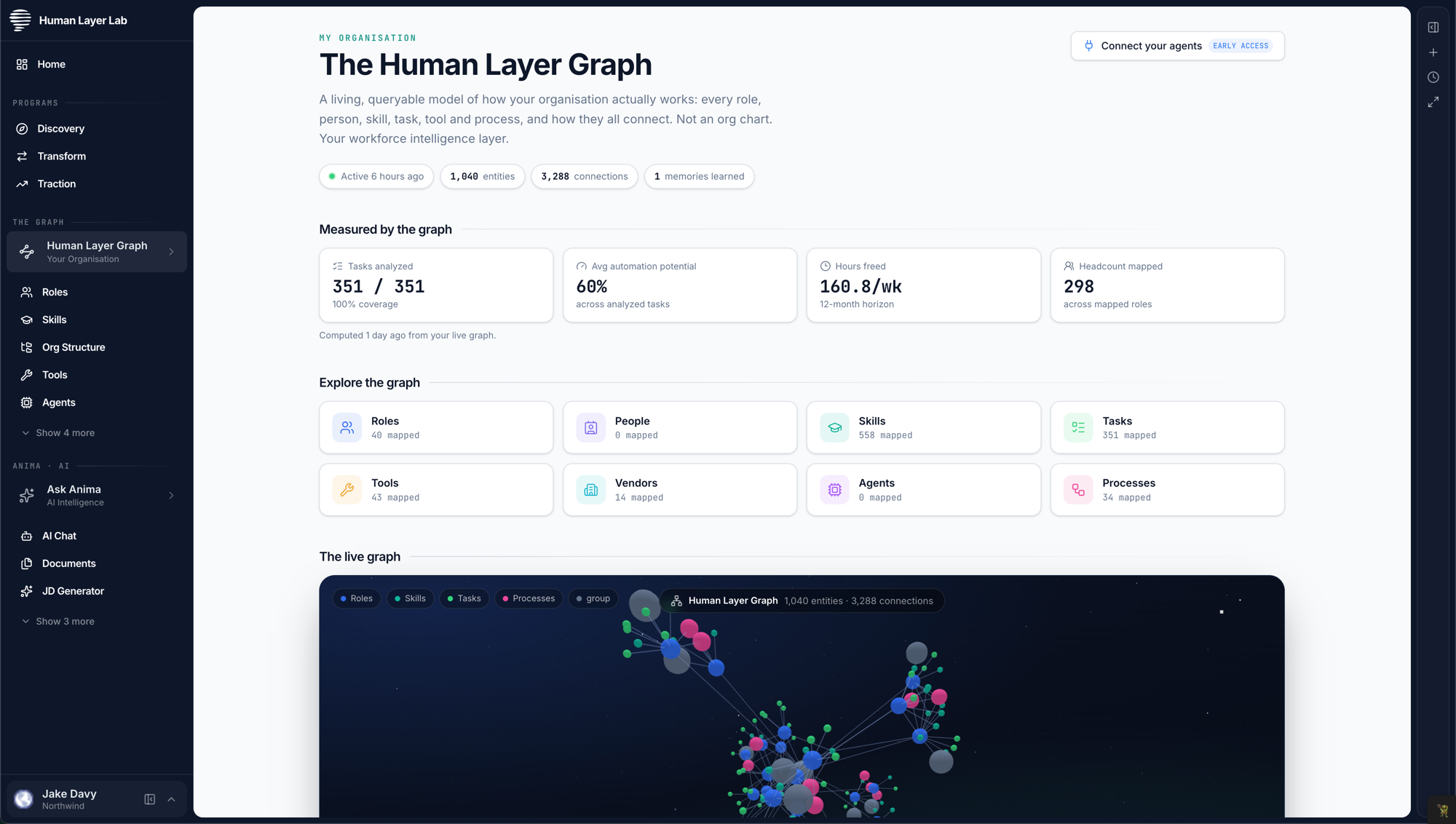
On screen1,040 entities and 3,288 connections, standing up from your own roles. The numbers underneath every document come from here.
The documents · six per role
Growth Report
The role's AI evolution path: which tasks AI takes on, which shift, which skills are emerging, and where the work grows from here.
Manager Brief
A plain operational summary for the person who runs the role, so the analysis lands with the people closest to the work.
AI Activation Plan
A practical, role-level roadmap for applying AI to the real tasks, with the skills to build alongside it. Not a generic list of prompts.
For the whole organisation
Workforce Impact Summary
An executive overview of how AI reshapes the workforce, with the capacity it can free read across the whole org in hours.
Department Rollup
The same analysis aggregated per department, so each leader sees their own team's picture, not the org average.
Living Job Descriptions
JDs rebuilt from what people actually do at task level, refreshed with AI competency expectations, so the written role matches the real work.
And they don't go stale. Every document is written from the graph and regenerates as the analysis moves, so the version in a leader's hand and the model underneath it never drift apart. Export any of them for a board pack; the live one stays live. Produced by Anima, our analysis engine, with human sign-off at every gate.
Two weeks, start to decision-ready.
A fixed shape, not an open-ended engagement. Our ingestion engine does the heavy lifting: it pulls your roles, structure and systems into a living organisation graph and works around the blockers, so it asks as little of your team's time as possible. You confirm at each gate; nothing runs on data you haven't signed off.
The scoping call
One session sets the scope: which roles are in, which department leads, and what leadership needs to be able to decide at the end.
Ingest your organisation
Not just roles. Org structure, processes, the systems your teams work in and the job descriptions you already have, from HRIS and system exports or entered by hand. Messy or out of date is fine; we work from what people actually do at task level. This is where your graph starts standing itself up.
Your team, with oursSet the direction
A short AI adoption survey, run with you, captures how AI-first you want to be and where the business is heading. This calibrates the analysis to your ambition, not a generic benchmark.
Run togetherThe analysis runs
Every role is broken down to its tasks and scored for AI impact, then mapped against the skills and tools around it. The graph stands itself up, and the first results land in as little as 24 hours.
Anima, our engineYou confirm, role by role
You review the analysis and sign off. Nothing generates on data your people haven't confirmed: the agents propose, your team decides.
Your callDecision-ready
The reports generate: per role, per department and across the org. Yours to export, and the platform underneath stays live.
That is the assessment on its own: your roles, analysed, written up and signed off. Most organisations then want one more layer.
Questions we get asked first.
What exactly do we receive?+
A working model of your organisation, and the documents that come out of it. The model is the graph: every role, task, skill and tool, and how they connect, with each role analysed task by task. From that, six board-ready documents: a Growth Report, Manager Brief and AI Activation Plan for every role, a Workforce Impact Summary and a per-department rollup across the org, and Living Job Descriptions rebuilt from the real work. Export any of them; the model underneath stays live.
How long does it take?+
First we ingest your roles and context, which can take a few days depending on volume and access. After that, the first analysis runs in as little as 24 hours. The rest is your team confirming the results, not waiting on us.
What do we need to bring?+
Your roles, however you have them: job descriptions to upload, a paste or a description, or a pick from our library. That is enough to start. The more business context you add, the sharper the analysis, and our engine flags any gaps for us to fill together.
What if our job descriptions are messy or out of date?+
No problem. We have a library of current job descriptions and market data to draw on, so you are not starting from a blank page. What we work from is what people actually do at task level, which we capture through a short internal survey with your teams and managers. You end up with JDs that finally match the real work.
What is the tools and vendors add-on?+
An option that extends the assessment beyond roles. We map every tool and vendor to the tasks they support, so the picture includes where AI overlaps the stack you already pay for. It scales with the number of roles, and it starts to connect your organisation into the full Human Layer Graph.
Can we trust the analysis?+
Every finding traces back to task-level evidence, and nothing runs without your sign-off. The agents propose, your people decide. Underneath is Anima, our analysis engine: deterministic and observable, with no black boxes and no lock-in to a single AI vendor, and every version audited.
What happens to our data?+
Encrypted in transit and at rest, held in a region named in your contract. Sensitive context can stay in your systems. Full detail in our Trust Center.
What happens after the assessment?+
The assessment builds your baseline. From there, Transform acts on it: org redesign, reskilling, redeployment, L&D, tool and vendor decisions. Traction then measures it landing with live data. The assessment is the way in, and it feeds everything after.

See AI's impact on every role, in days.
Start with the roles you already have. A living model of your workforce and the board-ready reports out of it, from $8,000 USD, with the first analysis back in as little as 24 hours.